
Graded card collecting, explained
Graded trading cards sit at the intersection of two worlds that used to be separate: a hobby people fell in love with as children, and an asset class that now trades in the same breath as fine art, watches, and rare coins. A graded card is a trading card that an independent company has authenticated, evaluated for condition, and sealed inside a tamper-evident case with a permanent grade and a unique certification number. That single act — turning a fragile piece of cardboard into a sealed, certified, comparable unit — is what made a casual pastime into a market measured in billions, with public sale records, population data, and price discovery that looks more like a stock exchange than a flea market.
This guide is written for the collector who wants to take that seriously without losing the joy of it. It is for the person who just pulled a card they suspect is worth real money and does not know what to do next; for the long-time hobbyist sitting on a closet full of slabs with no idea what the whole thing is worth or whether it is protected; and for the investor who treats cards as a portfolio and wants the discipline that any other asset class would demand. You do not need to be any one of those people. The principles are the same whether you own three cards or three thousand.
The through-line of everything that follows is a single idea: a collection is an asset to be valued and protected, not merely owned. Most collectors track exactly two numbers — what their cards are worth on paper and how good the grades are — and stop there. But owning an asset and protecting an asset are different disciplines. A vault of pristine grails that are uninsured, undocumented, and stored in a closet is a worse-protected asset than a modest, fully covered, diversified collection. The market is happy to tell you what a card is worth. It will never tell you whether you are about to lose it.
That is where the stakes live. The same forces that made graded cards valuable — liquidity, public comps, scarcity at the top grades — also made them targets for theft, vulnerable to fire and flood, and easy to mis-value the moment the market moves. The collectors who do well over time are not the ones who got luckiest on a single pull. They are the ones who built a repeatable practice: grade with intent, value from real sales, store securely, insure to live value, and document everything. This guide is that practice, chapter by chapter — the grading scale, the graders, comps, population reports, storage, insurance, the portfolio view, and finally a single number that ties protection together. Treat it as a reference you return to, not a thing you read once.
What a graded card actually is
Strip away the hype and a graded card is a very specific physical object: a trading card, encased in a rigid, sonically sealed plastic holder — universally called a slab — that cannot be opened without visibly destroying it. That tamper-evident property is the entire point. Once a card is slabbed, the market can trust that the card inside is the card on the label, in the condition the grade describes, and that nobody has swapped, trimmed, recolored, or otherwise altered it since the case was sealed. The holder is not packaging. It is a guarantee made physical.
On the label, three things do the work. The first is authentication — the grader has examined the card and certified that it is genuine, not a counterfeit or a reprint passed off as the real thing. The second is the grade, a number that summarizes condition on a standardized scale so that a buyer in one country can price a card a seller in another never has to describe in words. The third is the certification number, a unique identifier tied to that exact card in the grader database. Anyone can enter that number on the grader website and confirm the card, the grade, and the images on file. The cert number is what makes a slab traceable, insurable, and hard to fake, because a counterfeit slab has to counterfeit a real, verifiable record, not just a piece of plastic.
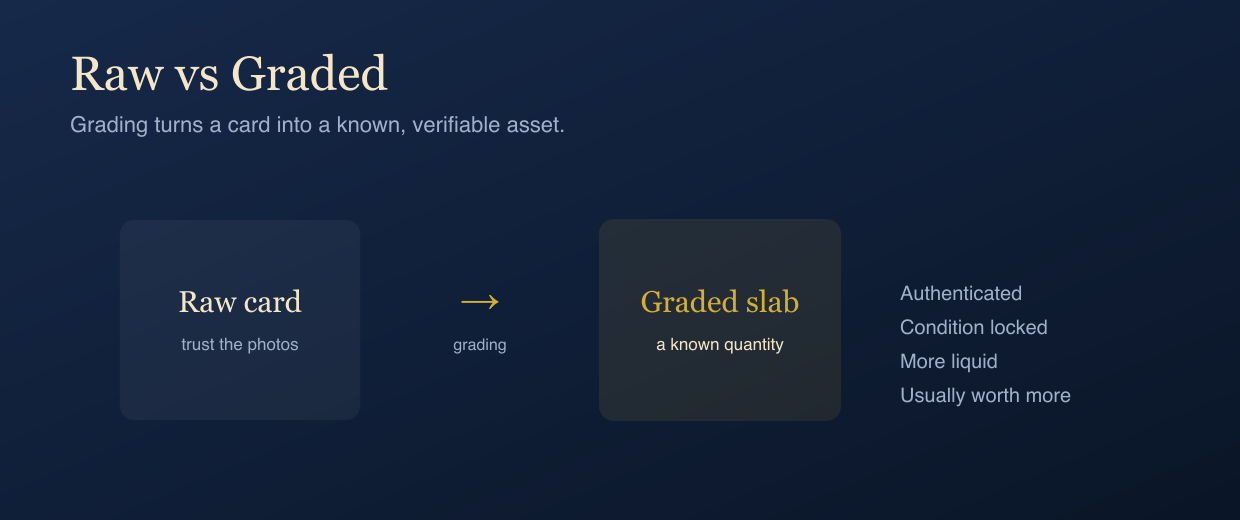
This is why slabs are more liquid and usually worth more than the same card raw. A raw card forces every buyer to make two leaps of faith at once: that the card is authentic, and that its condition is what the seller claims. Those are exactly the two questions that cause disputes, returns, and lowball offers. A slab answers both before the negotiation starts. The buyer is no longer pricing uncertainty — they are pricing a known, certified asset against the public record of what identical certified assets have sold for. Uncertainty is expensive, and removing it is worth money.
It is worth being precise about what the slab does and does not promise. It certifies authenticity and condition at the moment of grading. It does not freeze value, prevent the case from being damaged by heat or impact, or make the card immune to the market. A slab is a durable, trusted container for an asset — not a vault, not insurance, and not a price floor. Understanding that boundary is the difference between treating grading as a magic guarantee and treating it, correctly, as the foundation that everything else in this guide builds on.
Why people grade — and what it unlocks
People grade cards for four reasons, and it helps to keep them distinct. The first is authentication: a third party with no stake in the sale confirms the card is real. The second is condition certainty: instead of a seller adjective like near mint, you get a standardized number that means the same thing to everyone. The third is liquidity: a certified card sells faster and to a broader pool of buyers because it answers the questions that would otherwise stall a sale. The fourth is the premium: for cards in high grades, the certified version frequently sells for substantially more than the raw equivalent, and sometimes for a multiple of it.
The clarifying way to think about grading is as an investment decision, not a formality or a rite of passage. Grading costs money and ties the card up for weeks or months while the grade is determined. You are spending real capital and real time in the expectation that the certified card will be worth more, easier to sell, and safer to own than the raw one. Sometimes that math is obvious — a clean, high-end modern rookie or an iconic vintage card almost always justifies grading. Sometimes it is not — a common card whose graded value barely exceeds the cost to grade it is better left raw. Grading with intent means running that calculation before you submit, not slabbing everything reflexively.
The most useful mental shift is to stop thinking of raw and graded as the same card in two states, and start thinking of them as different assets with different markets. A raw card is a bet that includes condition risk and authenticity risk; its price reflects the discount a buyer demands for taking on those risks. A graded card has had those risks removed and priced out, and it trades in a deeper, more transparent market against public comps. The grade does not just describe the card — it changes what the card is, who will buy it, how fast it sells, and how you insure and track it.
There is one more thing grading unlocks that collectors underrate: a paper trail. A graded card comes with a verifiable record — the cert number, the grade, the grader images. That record is the spine of provenance. It speeds an insurance claim, it defends authenticity at resale, it supports premiums for well-documented copies, and it makes a collection vastly easier to value and to transfer to an heir. Grading is the moment a card stops being an anecdote and becomes an asset with a verifiable identity.
The 1 to 10 grading scale
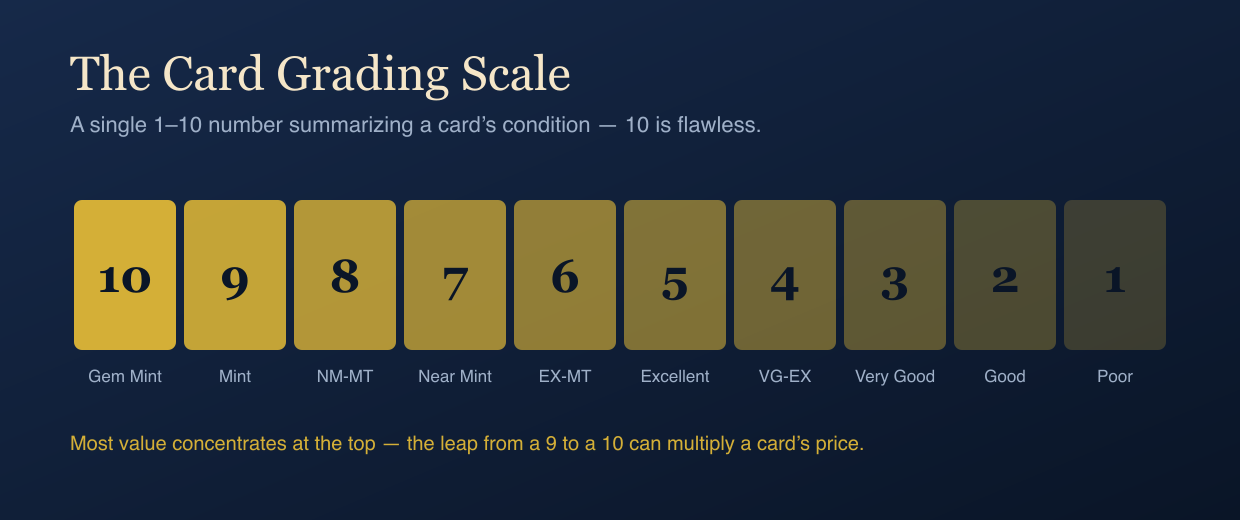
Across the major graders, condition is summarized on a scale from 1 to 10, where 10 — Gem Mint — is the ceiling and 1 is a card that has survived but little else. The lower and middle of the scale describe cards with visible, often significant wear: rounded corners, creasing, surface damage, off-center printing. These grades matter most for vintage and scarce cards, where a low-grade copy of something genuinely rare can still be valuable simply because few copies exist in any condition. For modern cards, the action is almost entirely at the top, because modern print runs are large and a worn modern common has little market.
The single most important feature of the scale is that most of the value lives at the high end, at 9 and 10, and that the leap from 9 to 10 is wildly out of proportion to the visible difference between the two cards. A 9, branded Mint, is a beautiful card with one small flaw — centering a touch off, a corner a hair soft, a faint edge nick, a tiny surface imperfection. A 10 is that same card with no such flaw. To the eye the two can look nearly identical, yet for sought-after cards the 10 can sell for a large multiple of the 9. You are not paying for a dramatically nicer card. You are paying for the scarcity created by the absence of one small defect that the scale punishes severely.
The scale also includes half grades and qualifiers that refine the picture. Half grades — a 9.5, for instance, used by some graders — split the difference between whole grades for cards that fall cleanly between them. Qualifiers are letter notes appended to a grade to flag a specific issue, such as off-center or a marked surface, that would otherwise be invisible in the number alone. These exist because a single integer cannot capture every nuance of condition, and because buyers want to know not just how high a card graded but why it did not grade higher. Some graders, notably Beckett, go further and publish subgrades for each condition factor on the label.
The practical takeaway is that a grade is part of a card identity, not a footnote to it. There is no such thing as the price of a card in the abstract — there is the price of a specific card, from a specific grader, at a specific grade. A 1999 Charizard is not one asset; it is a family of distinct assets, one per grade, each with its own population, its own buyers, and its own market. Treating a 9 and a 10 as the same card, or a PSA 10 and a CGC 10 as interchangeable, is the most common way collections get mis-valued and under-insured. The grade is not a label on the asset. It is part of the asset.
What actually determines a grade
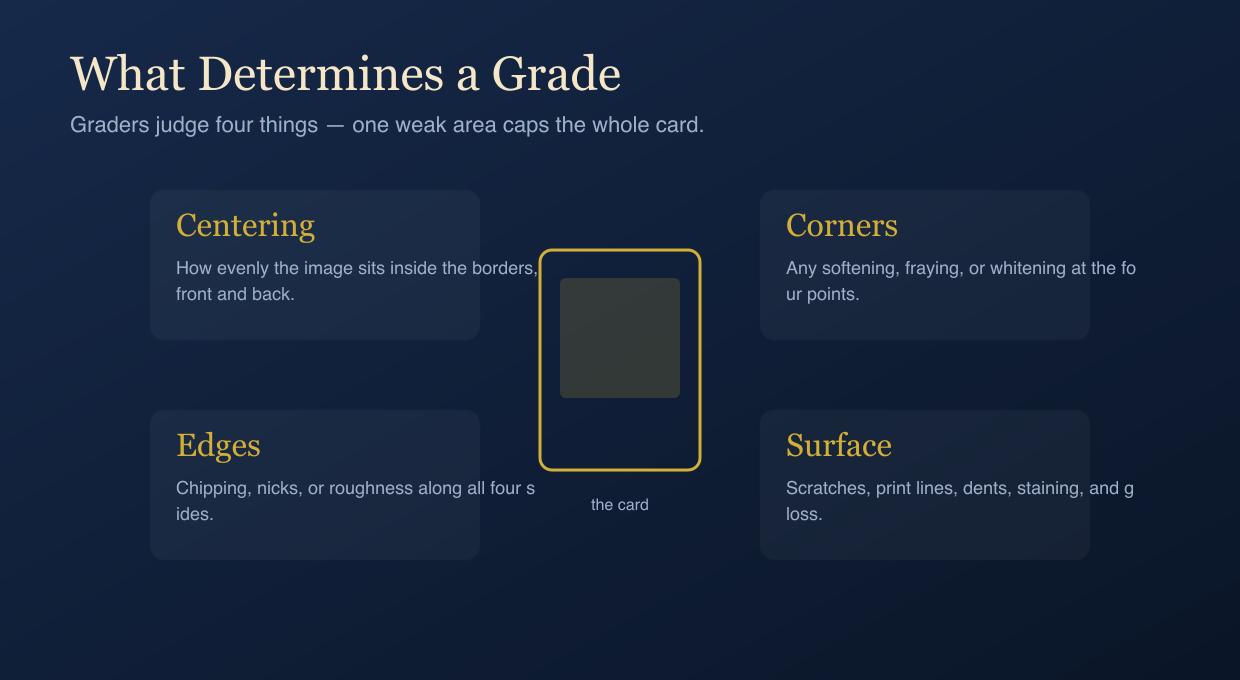
Every major grader evaluates a card on four factors: centering, corners, edges, and surface. Understanding them individually is the difference between guessing at a grade and predicting one. Centering measures how evenly the image sits within the borders, left to right and top to bottom. Graders express it as a ratio, and the tolerance tightens at the top of the scale — a card that looks centered to a casual glance can still miss a 10 on a measurable border imbalance. Centering is the factor most often responsible for an otherwise flawless card capping at a 9, because it is the one defect that is baked in at the factory and cannot be improved by careful handling.
Corners are the most fragile part of a card and the first to betray its history. A Gem Mint card needs four sharp, clean corners under magnification; the faintest fuzz, whitening, or softness drops the grade. Edges run a close second — graders look for clean, smooth, unchipped edges free of the whitening and nicks that come from handling and from the cutting process itself. Surface is the broadest factor and the hardest to fake your way past: print lines, scratches, scuffs, indentations, staining, loss of gloss, and printing defects all live here. On modern cards with heavy gloss and foil, surface flaws under raking light are a frequent grade-killer that the naked eye misses entirely.
The mechanic that ties these together, and that every serious submitter internalizes, is that the weakest axis caps the card. A card can be perfect on three factors and still grade a 9 — or lower — on the strength of a single weak one. Grading is not an average; it is closer to a floor set by the worst attribute. This is why a card with gorgeous corners and surface can be held back by centering alone, and why pre-screening means hunting for the one flaw that will define the grade, not admiring the three things that look great.
That hunt is the heart of pre-screening, and it is a skill worth building before you spend a dollar on submission. Examine the card under strong, angled light and ideally magnification. Check centering with a measured eye, not a hopeful one. Rotate the card to catch surface scratches and print lines that vanish at the wrong angle. Inspect every corner and run your eye along each edge. Be honest about what you find, because the grader will be. The goal of pre-screening is to predict the realistic grade and ask whether that grade justifies the cost — sending a card you hope is a 10 but suspect is a 9 is how submission budgets evaporate. The collectors who profit from grading are the ones who are ruthless about condition before they pay, not after.
Choosing a grader: PSA, BGS, SGC, CGC, TAG
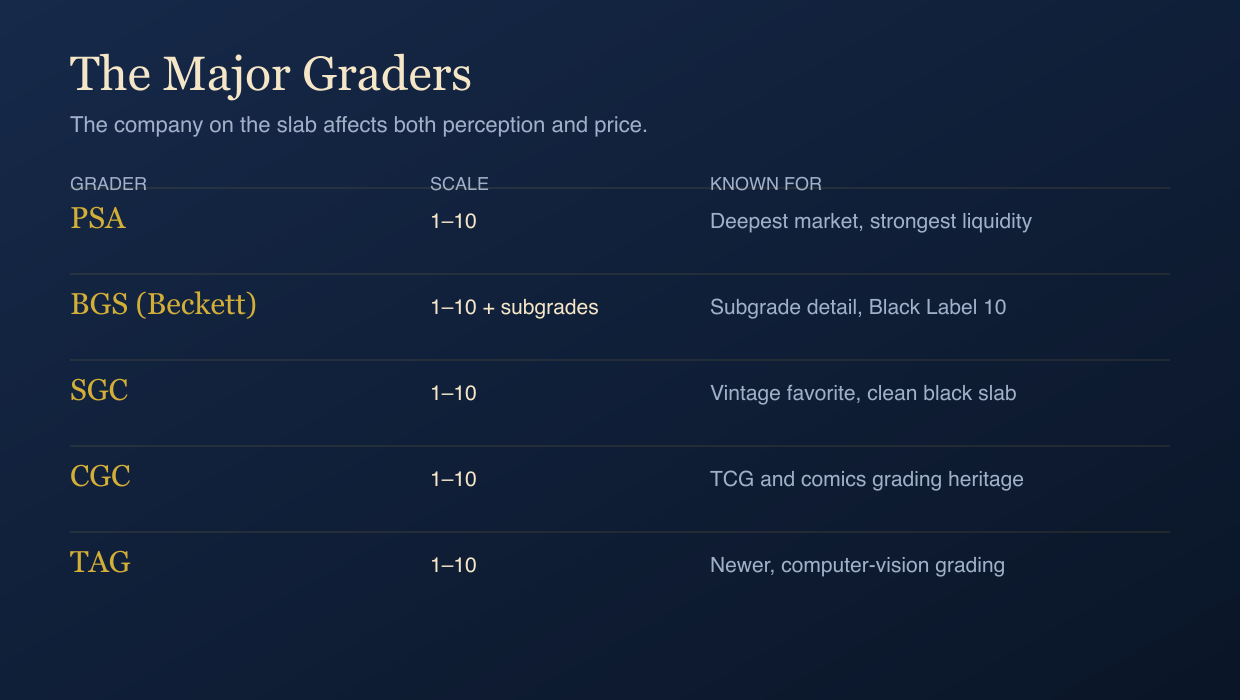
Five graders dominate the market, and each is a legitimate, widely recognized company — the differences are in scale, specialty, presentation, and how the market treats their labels. PSA (Professional Sports Authenticator) is the volume leader, especially across sports and vintage, and its slabs tend to anchor the deepest, most liquid resale markets. BGS (Beckett Grading Services) is long associated with modern cards and is known for its subgrades and the coveted Black Label. SGC (Sportscard Guaranty) holds strong standing in vintage, framed by a distinctive black tuxedo-style insert. CGC (Certified Guaranty Company) carries deep heritage from comic grading and has grown quickly in trading cards, particularly TCG such as Pokemon. TAG (Technical Authentication and Grading) is the newer, technology-forward entrant built around computer-vision grading and detailed digital reports.
The scales are broadly comparable but not identical. PSA, SGC, and CGC grade on the familiar 1-to-10 ladder, where most of the premium concentrates at the top, though each applies its own standards — a 9 from one grader is not mechanically the same as a 9 from another. BGS uses the same overall 1-to-10 scale but layers in subgrades, separate marks for centering, corners, edges, and surface printed on the label; when all four reach the top tier, BGS can issue its Black Label, a perfect-across-the-board designation that is genuinely rare and commands a premium far above an ordinary 10. TAG approaches grading from a different direction, using computer vision to assess the card and producing granular digital reporting in pursuit of a more transparent, measurement-based result.
Each grader has earned a reputation in a particular lane. PSA is the conventional pick for mainstream sports and blue-chip modern rookies where you want the broadest buyer base and tightest price discovery. BGS is hard to beat for high-end modern cards where condition nuance drives big swings and the subgrades and Black Label let you chase the absolute ceiling. SGC is the connoisseur preference in vintage, where its label carries real weight with the buyers who matter. CGC has fast-growing traction in TCG, Pokemon above all, where its heritage in authentication translates into a label many buyers trust. TAG is the forward-looking choice for collectors who value transparency and data and are comfortable being early to a newer standard.
The reason grader choice is more than a matter of taste is that the label follows the card for its entire life and shapes resale and liquidity. The same card in the same numeric grade can sell for different amounts across companies, because the market prices in each grader population, consistency, and the depth of its market for that card type. A grader with a deep, active market for a given card gives you tighter pricing and faster sales — that is liquidity, and it is real money when you need to sell. This is also why a value is only meaningful when tied to a specific grader and grade: a PSA 10, a BGS Black Label, an SGC 10, and a TAG 10 of the same card are four different assets with four different markets. The right move is to look at where comparable sales are deepest for that specific card, in its category, before you commit — the market will tell you which label it rewards.
Submitting a card the right way
A grading submission has two decisions baked into it that collectors often rush past: the service tier and the declared value. Graders offer tiers that trade cost against speed and against a maximum value the card can have to qualify, with higher-value cards requiring higher (and more expensive) tiers. The declared value is your honest estimate of what the card is worth, and it usually sets both the tier you must use and the protection the grader extends in transit. Declaring too low to save money can disqualify a card or leave it underprotected; declaring wildly high wastes money. Match the tier and declared value to the card realistically, the same way you pre-screened its condition realistically.
Packaging is where avoidable disasters happen. A card travels to the grader raw and vulnerable, and any damage it takes in transit becomes part of the grade. The discipline is to immobilize the card so it cannot shift, protect the corners and surface, and shield the whole package from bending and moisture. Use a penny sleeve and a snug semi-rigid or top-loader holder, avoid taping anything directly to the card, and pack the holders so they cannot slide against each other. The card you mail is the card that gets graded — a corner dinged in the box is a corner the grader will see and count.
Then comes the wait, and it matters more than collectors expect. From the moment you ship, the card is tied up — out of your hands, off the market, and unsellable — until it comes back graded. That window can run from weeks to months depending on the tier and the grader backlog, and during it the market can move for or against you. This is the hidden cost of grading: not just the fee, but the illiquidity. A card you might have sold raw today is frozen while it waits for a grade, which is one more reason to grade only when the expected payoff clearly justifies both the money and the time.
So when is a submission worth it? When the expected graded value, at the realistic grade you predicted in pre-screening, exceeds the raw value plus the grading cost plus the opportunity cost of the wait — with enough margin to be worth the risk that it grades a notch lower than you hoped. That math favors clean, high-end, and iconic cards and disfavors commons and cards likely to land in the middle of the scale. A distinct bet worth understanding is crack-and-regrade: cracking a card out of an existing slab to resubmit it, hoping for a higher grade or a more favorable grader. It can pay off, but it is a genuine gamble — you give up a certified grade and a clean cert history for a chance at a better one, and the card can come back the same or worse. Treat it as speculation, not a sure upgrade, and only on cards where the spread between grades is large enough to justify the risk.
Buying smart and avoiding traps
The first fork in buying is whether you are buying graded cards to hold or buying raw cards to grade and flip. Buying graded is the lower-risk path: the authenticity and condition questions are already answered, the card trades against public comps, and you know what you are getting. Buying raw to flip is a higher-variance game that depends entirely on your ability to read condition and predict a grade — the same pre-screening skill from earlier, now applied with your own money on the line. Both are legitimate. The mistake is doing the second while telling yourself it is as safe as the first.
Reading a listing is a skill in itself. For a graded card, confirm the grader, the exact grade, and the cert number, and verify that cert number on the grader website against the photos before you bid — a real cert returns a matching record and images. For a raw card, treat every seller adjective with suspicion and judge from clear, well-lit photos of all four corners, the edges, and the surface under angled light. Vague photos, no cert verification, or a price that looks too good against the comps are all reasons to slow down, not speed up.
The traps worth knowing cold are fake slabs and altered cards. Counterfeit holders exist, and the defense is the cert number: a fake slab has to fake a verifiable record, so a cert that does not check out, or photos on file that do not match the card in hand, is a hard stop. Altered cards — trimmed to improve centering, recolored to hide wear, or restored in ways that should disqualify them — are the subtler danger, which is precisely why third-party grading exists and why a trusted grader slab is your best protection. When buying raw, the risk of alteration is yours to absorb, and it is the strongest argument for buying graded when the stakes are high.
Finding value is less about secret tricks and more about discipline. Buy against realized comps, not asking prices. Be patient enough to wait for the right copy at the right price rather than overpaying into a hot market. And above all, lean toward buying fewer, better cards. A collection of a handful of strong, liquid, well-chosen pieces is easier to value, easier to insure, easier to sell, and more resilient than a pile of marginal cards bought on impulse. The collectors who compound over time are not the ones with the most slabs. They are the ones who said no the most often.
What a card is worth: valuing with real comps
There is exactly one credible way to value a graded card, and it is the comp method: look at what identical cards have actually sold for, recently, and let those realized prices define the value. The word that does all the work is realized — comps are completed sales, money that changed hands, not asking prices or listings that may never sell. An asking price is a hope; a realized sale is a fact. A value built on listings is a value built on what sellers wish their cards were worth, which is systematically higher than what buyers will pay.
A proper comp is exact, recent, and clean. Exact means the same card and the same grade from the same grader — a PSA 10 comps to other PSA 10s of that precise card, never to a 9, never to another grader 10, never to a generic version of the card. Recent means the market today, not a sale from a year ago in a different market regime, because card values move. Clean means removing outliers: the abnormally high sale to a determined bidder, the abnormally low sale to a buyer who got a deal or a card with a problem. The honest value is the center of the recent, realized, exact-match distribution, with the noise trimmed off.
This is why price guides mislead. A static guide figure is a snapshot that ages the moment it is printed, and it cannot reflect a run-up after a great season or a slide after a reprint. It also tends to blur grade and grader distinctions that the real market prices sharply. A price guide can be a rough orientation, but it is not a valuation, and treating it as one is how collections drift far from reality — usually toward over-confidence on the way up and under-insurance on the way down.
Sales volume is the quiet signal that tells you how much to trust a value. A card with many recent comps has a tight, confident price — the market has voted often and clearly, and you can predict the next sale within a narrow band. A card with only a handful of stale comps has a wide, uncertain value, because thin trading means the next sale could land far from the last one. Volume is not just a number; it is a confidence interval, and it is also a liquidity signal you will meet again in the portfolio chapter. This is exactly the method Slabline uses: every slab is valued from real comparable sales — recent transactions of the same card and grade, aggregated across the major marketplaces — so the value reflects what the market is actually paying rather than a guess or a guide.
Population reports and scarcity
A population report — pop report for short — is the grader census of how many copies of a given card it has certified at each grade. It is the closest thing the hobby has to a supply chart, a public ledger of how many 10s, 9s, 8s, and so on exist for a specific card from that grader. Where comps tell you what cards have sold for, the pop report tells you how many of them are out there at each grade, and reading the two together is how a serious buyer or submitter forms a complete picture of an asset.
Scarcity at a given grade is what drives premiums, and the pop report is where you measure it. The number that matters most is the ratio of the top grades to the grades just below — for example, how many 10s exist against how many 9s. A card with very few 10s sitting above a large pile of 9s has genuine structural scarcity at the ceiling, which can justify a fat premium for the 10. A card with nearly as many 10s as 9s has little scarcity to support a large gap, and a big premium there is paying for status, not supply. Scarcity without demand does not move price, but scarcity meeting demand is exactly where the largest premiums live.
Used well, the pop report informs two decisions before you act. Before submitting, it tells you whether the grade you are chasing is already common — if 10s are plentiful, the upside of landing one is thinner than you might hope. Before buying, it tells you whether the premium being asked is supported by real scarcity or is a status tax on a deep population. Read it with two cautions. Populations grow over time as more copies are submitted and crossed over, so a thin top-grade count today can swell and compress a premium you paid for. And the report is only half the equation — pair it with demand, because a low count only commands a premium when buyers are competing for those copies.
Population also explains something that confuses newcomers: why the same grade can sell for different prices. Part of the answer is grader, which you already know changes the market. Part is timing and comp quality. But part is the pop report itself shifting under your feet — a card whose top-grade population doubles is a different asset than it was, even though the grade on the label has not changed. The grade is fixed; the scarcity behind it is not. A collector who tracks the pop report alongside the comps sees value changes coming that a collector watching only the price never does.
Why card values change
Card values move for the same fundamental reason every asset price moves: supply and demand shift. On the demand side, the biggest single driver for sports cards is player performance — a breakout season, a championship, a record, or an injury can move a name overnight, because the card is partly a bet on a career. Hype cycles add their own demand swings: a card or a set catches fire, prices spike on momentum, and then cool as attention rotates elsewhere. And macro conditions matter more than collectors like to admit, because cards are a discretionary, speculative asset that breathes with the broader appetite for risk and the amount of disposable money in the market.
On the supply side, the levers are different but just as powerful. Set reprints and new product can dilute demand for an existing card. Most importantly, grading population growth steadily changes supply at each grade — every new 10 that comes back from the grader is one more unit competing with the existing 10s, which is why a scarcity premium you paid for can erode as the pop report fills in. Supply in this hobby is not fixed at the moment of printing; it keeps evolving as cards are pulled from collections, submitted, cracked, regraded, lost, and damaged. The number of high-grade copies in the world is a moving target.
Vintage and modern cards behave differently enough to deserve separate mental models. Modern cards have large, known print runs and high-grade populations that can grow quickly, so their values lean heavily on demand — player performance and hype — and a flood of new 10s can compress premiums fast. Vintage cards have a fixed, dwindling, and uncertain surviving population; a true high grade can be extraordinarily rare because decades of handling thinned the herd, and that structural scarcity tends to make vintage values more stable and more driven by supply than by the news cycle. Neither is inherently the better investment, but they reward different temperaments and different timeframes.
Because values move, valuation is not a one-time event — it is a maintenance task. A collection valued two years ago is, today, a collection valued at the wrong number, and the consequences are concrete: you are either under-insured after a run-up or over-paying premium after a dip, and you cannot judge your own risk against numbers that have gone stale. The right cadence is to revalue continuously from live comps rather than on an annual appraisal calendar, especially for modern cards where populations and hype move fast. A value is only as useful as it is current, which is why Slabline re-values from recent comparable sales rather than freezing a figure in time.
Storing and protecting your slabs
The failures that destroy the most collection value are not market crashes — they are physical, boring, and entirely preventable. Heat and humidity are the slow killers: they can warp slabs and fog the inner well over time, quietly degrading cards that are otherwise pristine. Direct light, especially UV, fades inks and surfaces. Large temperature swings stress the case. And then there are the sudden catastrophes — fire, flood, and theft — that can erase a collection in a single event. A slab is more durable than a raw card, but it is not indestructible, and the grade on the label means nothing if the asset is gone.
Good storage starts with environment. Aim for cool, dry, dark, and stable: climate-controlled interior living space, not an attic that bakes, a garage that swings with the seasons, or a basement that floods. Keep slabs out of direct and prolonged light. Handle them by the edges, transport them in dedicated slab cases rather than loose, and never stack heavy objects on them or slide them against one another in a way that can scuff the holder. The case protects the card from contact, but the collection around the case still depends on you to control its surroundings.
Security scales with value. For a collection worth real money, a fireproof safe or a safe-deposit box materially lowers both theft and disaster risk, and for the highest-value pieces, off-site or third-party vaulting separates your crown jewels from a single-location catastrophe. The organizing principle is simple and worth stating plainly: no single event in one room should be able to wipe out the collection. If your entire collection lives in one drawer in one house, you are one bad day away from losing all of it at once, no matter how good the cards are.
Organizing a growing collection is part of protection, not just tidiness. A collection you cannot inventory is a collection you cannot insure, value, or recover. Keep a current, itemized record of what you own — card, grader, grade, cert number, and value — so that you can prove the collection exists, document a loss to a claims adjuster, and hand a coherent asset to an heir. Storage is, in the end, the cheapest insurance there is: it costs far less to prevent a loss than to be made whole after one, and unlike a market downturn, a storage failure is entirely within your control.
Insuring your collection — the gap most collectors miss
The most common and most expensive failure in the entire hobby is under-insurance, and it usually comes as a surprise. A standard homeowners or renters policy treats collectibles as a minor category, capping them at a low sub-limit — often a few hundred to a couple thousand dollars total — and frequently lumping them in with jewelry and electronics. If a collection worth tens of thousands of dollars burns, floods, or is stolen, a standard policy makes you whole on a tiny fraction of it. Most collectors assume their existing coverage has them protected. For a collection of any real value, it almost certainly does not.
Closing that gap means moving beyond the base policy to coverage built for collectibles. The two common routes are a scheduled personal property rider added to your existing policy, which itemizes and insures specific high-value items above the standard sub-limit, and a dedicated specialty collectibles policy from an insurer that underwrites this asset class directly. Both raise the limit and broaden the covered loss types, and both share one non-negotiable requirement: the carrier needs an itemized, valued list of what you own. They will not insure a vague total. They insure a documented schedule.
That schedule is the thing most collectors do not have, and it is the bottleneck to getting properly covered. A broker-ready schedule lists, per card, the exact card (year, set, player or character, number), the grader and grade, the certification number, and a current market value backed by recent comparable sales — plus a collection total and the date valued. The values must be defensible, because an underwriter will scrutinize them, and they must be current, because coverage sized to last year market can be badly short after a run-up. This is precisely the document Slabline generates automatically: a Schedule and Risk Report built from real comps that you can hand straight to your own broker.
Know what to do after a loss, because the documentation you keep now is what determines what you recover then. A clean schedule, verified cert numbers, purchase records, and photographs turn a claim from a dispute into a process — you can prove what you owned, what it was worth, and that it was genuine. Keep that record current and stored somewhere it will survive the same event that destroys the cards, off-site or in the cloud. One boundary worth stating clearly: Slabline is not an insurer or a broker. It produces the valuation and documentation; you take that to your own licensed insurer to obtain the actual coverage. The tool closes the documentation gap. The policy closes the financial one.
The portfolio view: concentration, liquidity, provenance
The collectors who last treat their cards the way a disciplined investor treats a portfolio, and that lens reveals risks that a simple total value hides completely. A collection is not just a sum of what each card is worth; it is a structure with its own exposures, and three of them — concentration, liquidity, and provenance — determine how resilient that structure is to a shock. Total value tells you what you have on a good day. These three tell you what you keep on a bad one.
Concentration is fragility from a single point of failure. A collection that is heavily weighted toward one player, one set, or one card is not really diversified — it is a leveraged bet on one career, one print run, and one corner of the market. When that player gets hurt, that set gets reprinted, or that grade floods the population report, the whole collection moves together, and usually downward, all at once. Diversification across players, categories, and eras does not make any single card more valuable; it makes the whole resilient to a shock in any one area, so that one bad headline cannot sink the ship. Spreading value across enough independent buckets is the difference between a portfolio and a bet.
Liquidity measures how readily your holdings convert to cash near their market value. A blue-chip modern rookie in a top grade sells in days at a price you can predict within a few percent; an obscure slab in a thin market can sit for months or only move at a real discount to its theoretical value. The number on the screen is only worth what a buyer will actually pay this week, and that gap matters most at exactly the wrong moment — when you need cash quickly, are settling an estate, or want to rebalance out of a concentrated position. A collection weighted toward liquid, widely traded cards is one you can turn into money without a fire sale. This is the same sales-volume signal from the comps chapter, viewed as a property of the whole portfolio.
Provenance is the documentation — verified certification numbers, grading pedigree, and purchase records — and it is the quiet underwriter of everything else. A clean paper trail speeds an insurance claim, defends authenticity at resale, supports premiums for well-pedigreed copies, and makes a collection far easier to value and to transfer. It is the lightest of the three to maintain and the easiest to neglect, yet it is what makes the other two protections actually pay off. Concentration and liquidity describe the shape of the portfolio; provenance is what lets you prove, claim, and transact against that shape when it counts. Together, the three turn a pile of slabs into a managed asset.
The collection as an asset: the Slabline Score
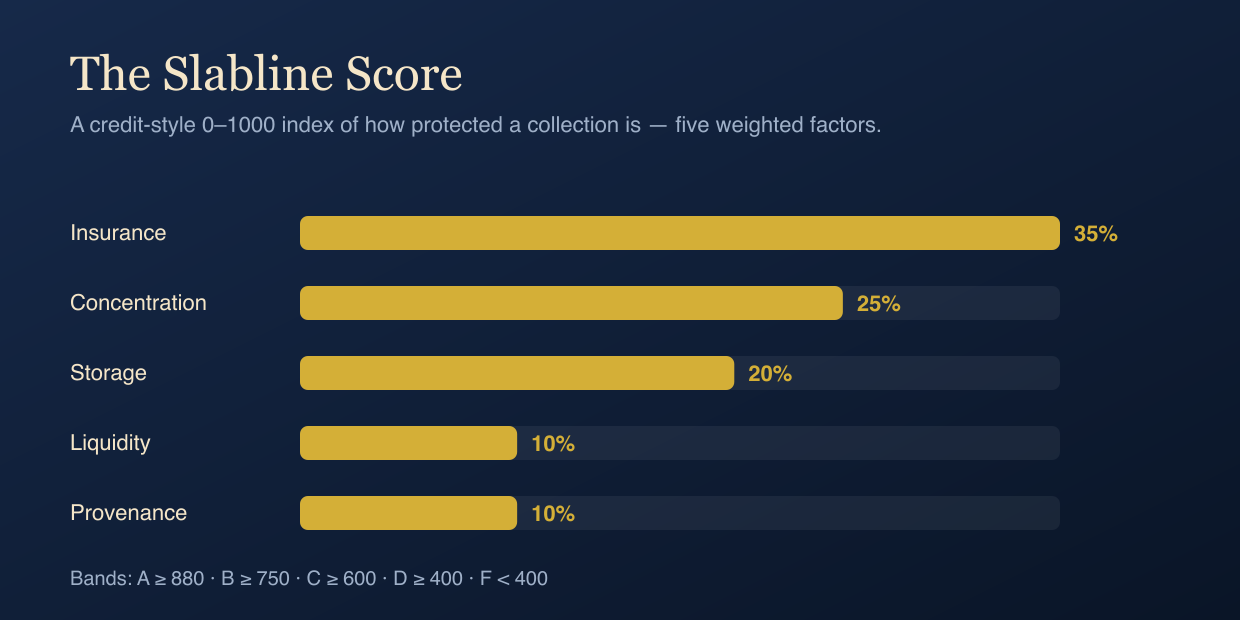
Every chapter so far has measured one slice of risk — grading, valuation, storage, insurance, concentration, liquidity, provenance. The Slabline Score pulls them into a single number. It is a credit-style 0-to-1000 index of how well-protected a collection is, modeled on the logic of a credit score: a FICO score does not rate how nice your house is; it tells a lender how risky you are to extend credit to. The Slabline Score works the same way for a collection — it does not rate your cards, it rates your exposure — and like a credit score, higher is better.
The Score blends five weighted factors, and the weights reflect how much damage each can do. Insurance is weighted heaviest at 35%, because under-insurance is the most common and most expensive failure in the hobby, and the factor measures the gap between what you are covered for and what your slabs are actually worth at live market value. Concentration is 25%, scoring fragility from a single player, set, or card. Storage is 20%, the physical risk from heat, humidity, light, fire, theft, and handling. Liquidity is 10%, how readily you could sell near fair value. Provenance is 10%, the strength of your documentation and paper trail. Each measures a distinct way a collection can quietly lose value or become hard to recover, and together they sum to one figure.
The 0-to-1000 result maps to five letter bands so you can read your standing at a glance: A for 880 and above is well-protected and genuinely rare; B for 750 and above is solid with minor gaps; C for 600 and above is typical, almost always with one real gap, usually insurance or concentration; D for 400 and above is exposed, where a loss event would be painful and only partly recoverable; and F below 400 is critical, a collection that is essentially unprotected. Most collections start in the C-to-D range for the same reason — they are under-insured — which is not a personal failing so much as the result of the hobby never having had a tool that put a number on it.
It is essential to be clear about what the Score rates and what it does not. It rates protection, not card quality. A pristine grail can sit inside an F-rated collection if it is uninsured and stored badly, and a thoughtful, fully covered collection of mid-grade cards can score an A. The Score is not an appraisal, an insurance policy, or a prediction of future price, and Slabline is not an insurer or a broker — the values behind the Score are estimates from recent comparable sales, not certified appraisals or financial advice. What the Score does that nothing else does is make risk improvable. Because it is live, each protective action you take — adding coverage, diversifying a future buy, securing storage, verifying certs — moves the number as you do it, turning an abstract worry into a concrete, prioritized metric you can actually raise.
Selling a graded card or a whole collection
Selling well starts with knowing when to sell, and the discipline is to sell against the data rather than against your emotions. The right moments tend to align with strength: demand is high, recent comps are robust, and the card is liquid enough that you can exit near its market value rather than at a discount. The wrong moments are forced ones — needing cash quickly, dumping into a cooling market, or selling a thin-market card under time pressure. The portfolio chapter framed this as liquidity risk; selling is where that risk becomes real, because the value on the screen only matters if a buyer is there to pay it this week.
Choosing a venue is a trade-off between reach, fees, and the kind of card you are selling. Broad marketplaces offer the largest buyer pool and the deepest price discovery, which suits liquid, widely traded cards. Specialist auction houses can extract more for high-end, trophy, and vintage pieces by putting them in front of motivated, deep-pocketed bidders, though they take time and a cut. The right venue is the one with the deepest market for your specific card — the same logic as finding comps, applied in reverse. Sell where identical cards already trade most actively, because that is where pricing is tightest and buyers are waiting.
Timing and presentation are where you capture or leave money. Time the sale against the comps and the card liquidity — list when recent realized sales are strong and the market is active, not when the last few comps are stale or sliding. Present the card with its full provenance: clear photos, the verified cert number, the grader and grade stated exactly, and any acquisition history that supports authenticity and pedigree. A buyer pricing a well-documented, easily verified card pays more and disputes less than a buyer squinting at a vague listing. The paper trail you kept all along is what lets the card sell at the top of its range instead of the middle.
Finally, sell on net proceeds, not headline price. Every venue takes fees, and a higher gross at a higher fee can net less than a lower gross at a lower one. Account for the marketplace or auction commission, payment processing, shipping and insurance in transit, and any consignment cut before you compare offers. When selling a whole collection, the same arithmetic compounds, and the concentration and liquidity profile of the collection determines whether you can sell it cleanly in a block or must work it down piece by piece. The number that matters is what lands in your account after everything is paid — and the collector who tracks that figure, not the sale price, is the one who actually knows what the collection was worth.
Collecting by category
The framework in this guide — grade with intent, value from real comps, read the pop report, store securely, insure to live value, document everything — is universal, but every category has its own value levers, and knowing them is the difference between a generalist and an expert in a lane. The principles do not change across categories. What changes is which specific attributes the market rewards, and learning those attributes for your category is how you apply the same discipline with real precision.
In trading card games — Pokemon above all, but the logic carries to other TCGs — value concentrates around set, edition, and rarity. The earliest and most iconic sets command the most, first-edition and shadowless variants carry premiums over later printings, and rarity tiers and special foils within a set separate the chase cards from the commons. Condition sensitivity is high because beloved early cards were handled by children, so high grades on vintage TCG can be genuinely scarce. The grader lane matters here too: CGC has grown fast in Pokemon, and where a card sells most actively should guide both how you grade it and how you value it.
In sports cards, the dominant levers are rookies, parallels, and vintage. Rookie cards — a player first licensed card — anchor demand because they are the foundational collectible for a career, and they swing hardest on player performance. Parallels and inserts create scarcity within a modern set through limited print runs, colored variations, and numbered editions, so two cards of the same player from the same set can be worlds apart in value. Vintage sports cards run on a different engine entirely: fixed, dwindling surviving populations make structural scarcity the driver, and a true high grade on a decades-old card can be extraordinarily rare. The same comp-and-pop discipline applies, but the levers you watch are player news for modern and surviving population for vintage.
The unifying point is worth stating plainly: every category has its own value levers, but all of them sit on the same grade, comp, and protect framework. Whether you collect Pokemon, basketball rookies, vintage baseball, or any other category, you value from real sales of the exact card and grade, you read the population for scarcity, you store the slabs securely, you insure to live value, and you document provenance. The expertise is in the levers; the discipline is universal. A collector who masters the framework can move into a new category and be dangerous quickly, because the hard part — treating the collection as an asset to be valued and protected — travels with them.
- The Definitive Guide to Pokémon Cardsread →
- How to Value Pokémon Cards (Graded & Raw)read →
- How to Value Sports Cards (Rookies, Parallels & Grades)read →
- How to Value Yu-Gi-Oh Cards (Graded & Raw)read →
- How to Value One Piece Cards (Graded & Raw)read →
- How to Value Magic: The Gathering Cards (Graded & Raw)read →
- VeeFriends Cards: A Newcomer’s Guideread →
- The Most Valuable Pokémon Cards (Graded)read →
- Iconic Sports Card Rookies Every Collector Knowsread →
- First Edition vs Unlimited Pokémon Cards: What’s the Difference?read →
- What Is a Rookie Card (and Why Are They Worth More)?read →
- What Are Card Parallels (and Why Some Cost 100x More)?read →
- What Is a Short Print (SP / SSP)?read →
Glossary and where to go next
A few essential terms tie this guide together. A slab is the rigid, tamper-evident case a grader seals a card into, carrying the grade and a unique certification number. A comp (comparable sale) is a recent, realized, exact-match sale used to value a card — the same card and grade actually sold, not an asking price. A pop report (population report) is the grader census of how many copies of a card it has certified at each grade, the hobby supply chart. Gem Mint is the top grade, a 10, signaling a card that is essentially flawless across centering, corners, edges, and surface.
A parallel is a variant of a base card distinguished by a different color, finish, or limited print run, common in modern sports cards and central to how scarcity is engineered within a set. A rookie card is a player first licensed card and the foundational collectible for that career. Provenance is the documented history of a card — verified cert number, grading pedigree, and purchase records — that proves authenticity and ownership. Concentration is the portfolio risk of being too heavily weighted toward a single player, set, or card. Liquidity is how readily a card converts to cash near its market value, a property of both the individual card and the whole collection.
Hold those terms together and the through-line of the entire guide comes back into focus: a collection is an asset to be valued and protected, not merely owned. You grade with intent, you value from real comps, you read the pop report for scarcity, you store securely, you insure to live value, and you document provenance — and the Slabline Score ties that protection into a single, improvable number across insurance, concentration, storage, liquidity, and provenance. The cards are the fun part. The discipline is what keeps them worth something.
Where to go next is simple. You can build your own Slabline Score free for up to 25 cards by scanning the certification label on each slab — Slabline reads the cert, values the card from real comparable sales, and computes your protection score across all five factors in seconds. From there you get a broker-ready insurance schedule and a clear, prioritized path to a stronger number. Start with a few of your best slabs, see where you stand, and let the Score show you the one gap worth closing first.